
Employee Core Details

Overview The Employee Core Details view defines the canonical employee object within the Common Data Model (CDM). It establishes a stable and consistent representation of each employee by combining identity, descriptive attributes, and system linkages into a single, governed structure. This view forms the foundation for all employee-related domains, enabling consistent joins, secure identity handling, … Read more
Release 94

Summary of Impact 🔧 Project Domain Enhancements Project Meta Codes – Roles Project Meta Codes (Core View) Project Manager Attribute – Reinstated Project Item Codes (UKS) 👤 Person Domain (New) Core Views Person Meta Codes 🧾 Invoice Domain Update Invoice Meta Codes 📊 Business Opportunities (APC) busopp_details_plus_APC 💰 Finance Domain Expansion Accounts Receivable – Item … Read more

Building a Robust Data Engineering Utility Layer in Microsoft Fabric

Modern data platforms are not built on single scripts or ad‑hoc notebooks. They rely on reusable, well‑designed utility functions that handle extraction, transformation, auditing, and historical tracking in a consistent way. This article walks through a real‑world Python utility module used in Microsoft Fabric, explaining every major function, what problem it solves, and how it … Read more

Condensed META_TYPE Taxonomy for Analysts

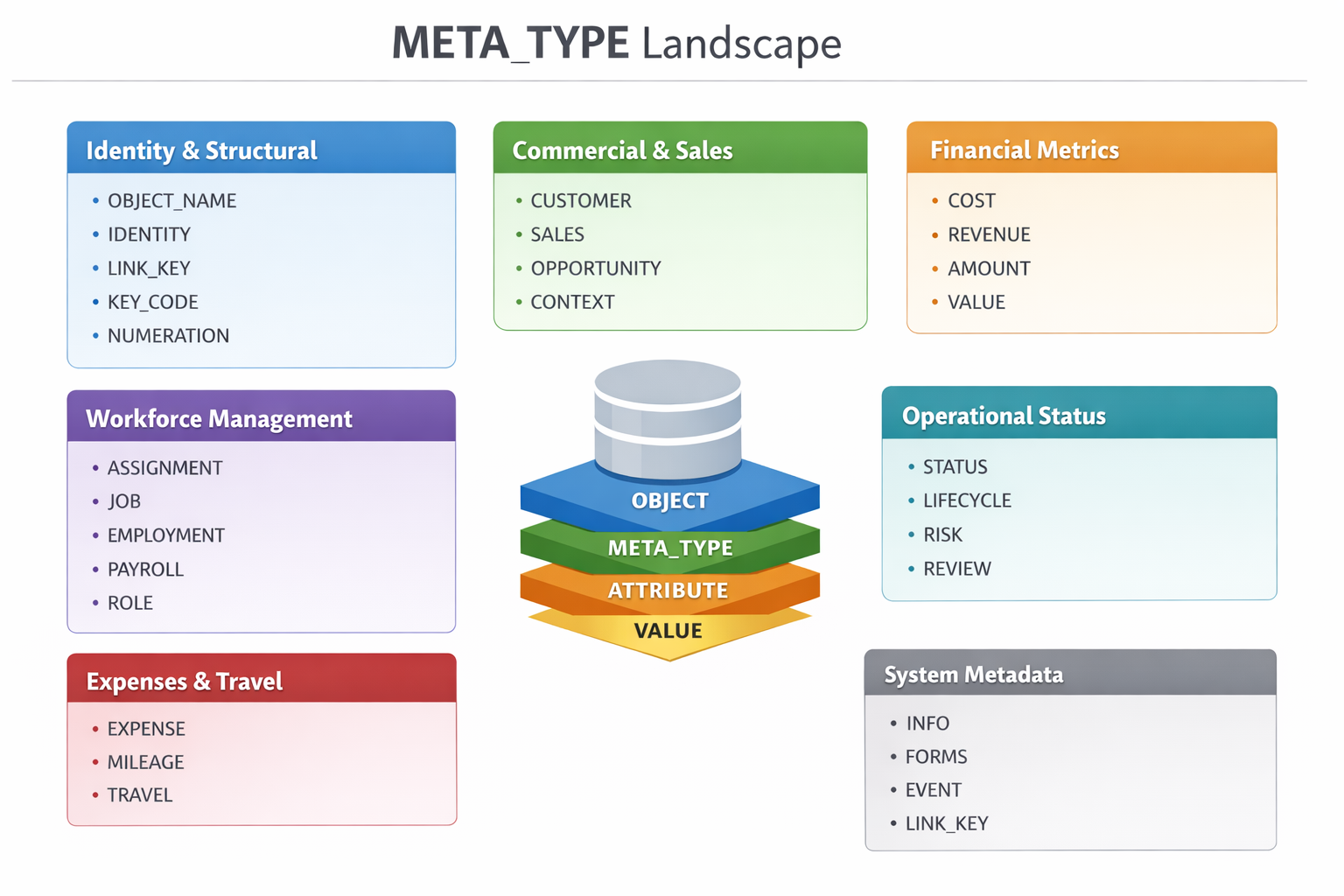
1. Identity Core identifiers and object naming. PurposeObject identifiers. 2. Structural Keys Structural identifiers used to link datasets. PurposeIdentify or reference core business entities. 3. Commercial Context Customer and contractual relationships. PurposeDescribe commercial relationships and contracts. 4. Sales & Pipeline Sales organisation and opportunity tracking. PurposeAnalyse pipeline, opportunity probability, and sales ownership. 5. Financial Values … Read more

Guide to META_TYPES in the CDM Data Views

Purpose META_TYPE is used within CDM metadata views (such as meta_codes, meta_dates, and meta_values) to group related attributes into meaningful analytical categories. Rather than storing hundreds of unrelated attributes, META_TYPE provides a semantic grouping layer that helps analysts understand the nature of the data. Each row therefore follows a pattern similar to: OBJECT → META_TYPE … Read more

Project.meta_codes roles

Provides project role assignment metadata in the standard CDM meta_codes structure, with regional view variants for APC, CAD, USD, UKS, and future IFS-aligned sourcing. Purpose The project.meta_codes_roles family provides a standardised project-role metadata pattern for identifying named project responsibilities against a project object. This allows project role assignments to be consumed consistently across regions even … Read more

How to Parameterise Dataflow Gen2 Destinations for Seamless Dev/Prod Deployment

Managing Dataflow Gen2 across multiple environments (Development and Production) can be a headache. By default, the destination Lakehouse or Warehouse IDs are hardcoded. This means when you deploy to a Production workspace, your dataflow might still try to write back to your Development environment. In this guide, I’ll show you a workaround to parameterize your … Read more

Release 93

Release 92 absorbed in DEV Pipeline Release validation 1. BusOpp (EUR & NA) – Structural Refactor Views affected What has changed We have refactored the MP8 / MP9 source logic to remove duplicated transformation code and consolidate the sources via an early UNION pattern. The primary driver was identification of multiple editions of the same … Read more