
Employee Core Details

Overview The Employee Core Details view defines the canonical employee object within the Common Data Model (CDM). It establishes a stable and consistent representation of each employee by combining identity, descriptive attributes, and system linkages into a single, governed structure. This view forms the foundation for all employee-related domains, enabling consistent joins, secure identity handling, … Read more
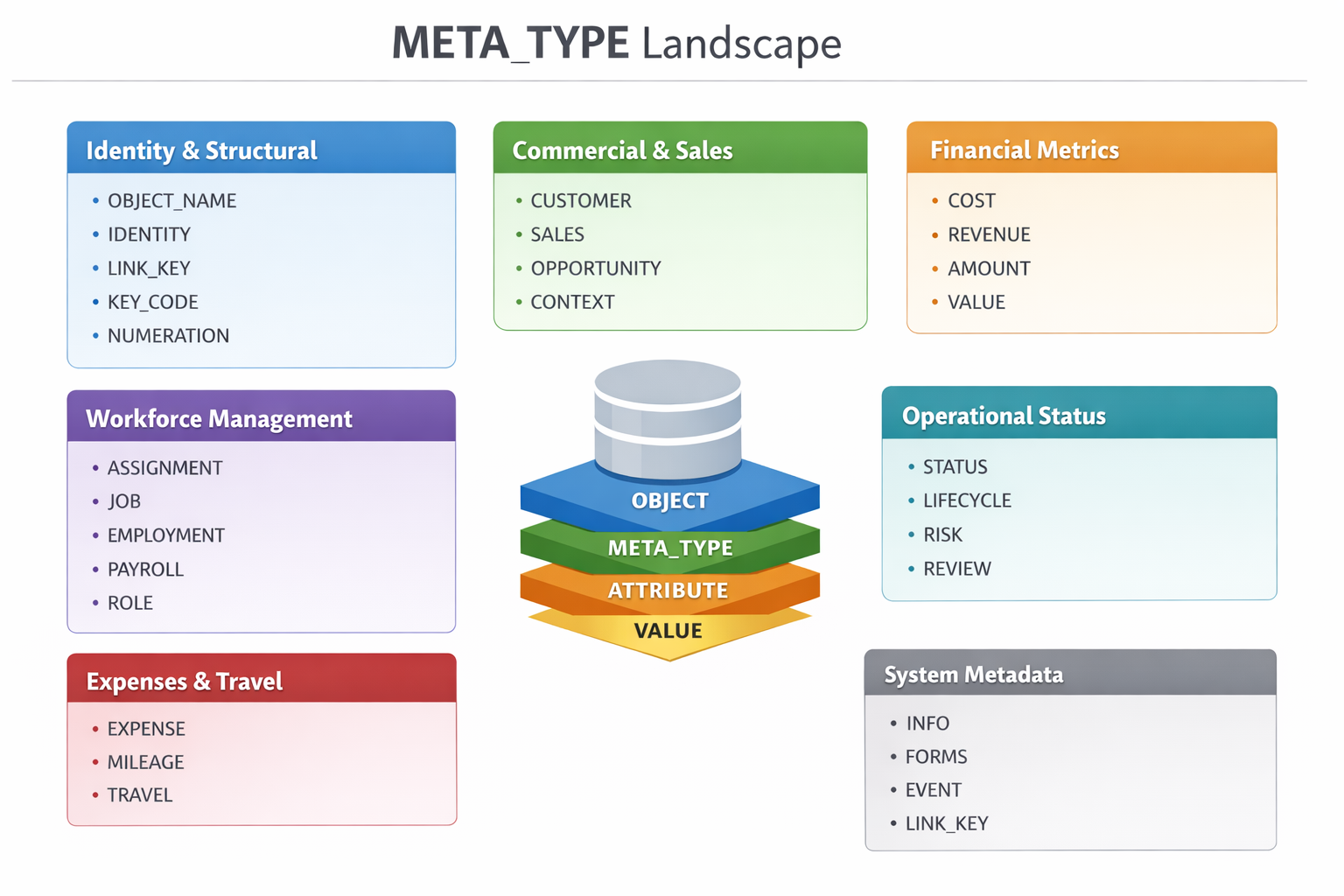
Condensed META_TYPE Taxonomy for Analysts

1. Identity Core identifiers and object naming. PurposeObject identifiers. 2. Structural Keys Structural identifiers used to link datasets. PurposeIdentify or reference core business entities. 3. Commercial Context Customer and contractual relationships. PurposeDescribe commercial relationships and contracts. 4. Sales & Pipeline Sales organisation and opportunity tracking. PurposeAnalyse pipeline, opportunity probability, and sales ownership. 5. Financial Values … Read more

Guide to META_TYPES in the CDM Data Views

Purpose META_TYPE is used within CDM metadata views (such as meta_codes, meta_dates, and meta_values) to group related attributes into meaningful analytical categories. Rather than storing hundreds of unrelated attributes, META_TYPE provides a semantic grouping layer that helps analysts understand the nature of the data. Each row therefore follows a pattern similar to: OBJECT → META_TYPE … Read more

Project.meta_codes roles

Provides project role assignment metadata in the standard CDM meta_codes structure, with regional view variants for APC, CAD, USD, UKS, and future IFS-aligned sourcing. Purpose The project.meta_codes_roles family provides a standardised project-role metadata pattern for identifying named project responsibilities against a project object. This allows project role assignments to be consumed consistently across regions even … Read more

ReportingUnit: Item_Values Budget

ReportingUnit.item_values_budget provides the budgeted order intake value at Reporting Unit (PRU) level, structured as an item-values dataset so it can be joined consistently with other CDM-style domains (actuals, forecasts, pipeline, etc.). It is sourced from sales.order_intake_budget, which is derived from the Finance-controlled budget workbook in SharePoint, and then reshaped into the standard OBJECT + ITEM … Read more

Order: item_dates stage

Order.item_dates_stage captures the order lifecycle timeline as a status-history “item” table. Each row represents a single lifecycle event (a status entry) for an order, with the event date carried as a meta-date value and the event details stored as JSON metadata. Use it when you need to answer questions like: Grain and keys This is … Read more

MP8 / MP9 – Regional BusOpp Data View Development Process

What this is MP8 and MP9 are regional “Opportunity & Order Intake” extracts used to provide sales pipeline and win/loss visibility where the opportunity lifecycle is not yet fully represented in IFS (or where we need historic continuity). This logic standardises the two extracts into a single, report-ready shape that aligns to our BusOpp-style reporting … Read more

Project.Item_Values

What this view is for Project.item_values provides the numeric and financial measures for projects. Where: If you’re asking:“how much has this project cost?”,“how much revenue has it generated?”, or“what is the current forecast or contingency?” — this is where you look. Architectural maturity This view is delivered as a cvw (collated view). It is assembled … Read more

MP8 / MP9 Import Process

The MP8 and MP9 import process is used to bring regional opportunity and order-intake information from Finance spreadsheets into the Data Warehouse in a consistent and repeatable way. What this process is for This process ensures that: It is primarily used where opportunities exist in regional or pre-IFS systems and are not yet fully represented … Read more

Project.Meta_Dates

What this view is for Project.meta_dates provides the date-based and lifecycle attributes for projects. Where Project.core_details defines what a project is,and Project.meta_codes defines how a project is classified,Project.meta_dates defines when things happen in the life of a project. If you’re asking “when did this project start?”, “when is it due to finish?”, or “when did … Read more